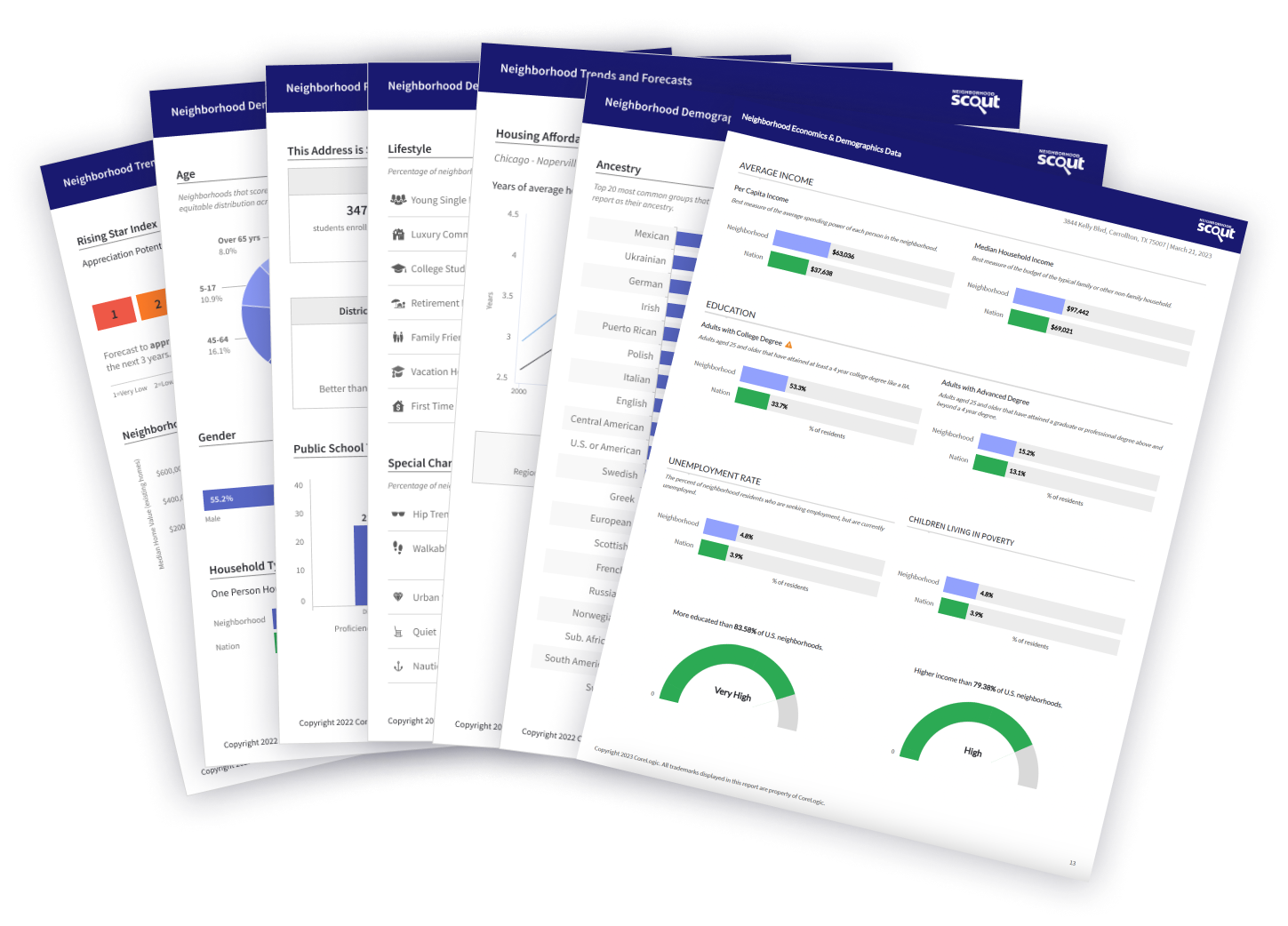
St. Augustine Shores Estates median real estate price is $503,691, which is more expensive than 61.5% of the neighborhoods in Florida and 64.0% of the neighborhoods in the U.S.
The average rental price in St. Augustine Shores Estates is currently $2,545, based on NeighborhoodScout's exclusive analysis. Rents here are currently lower in price than 47.3% of Florida neighborhoods.
St. Augustine Shores Estates is a rural neighborhood (based on population density) located in St. Augustine, Florida. This is a coastal neighborhood (i.e., is on the ocean, a bay, or inlet).
St. Augustine Shores Estates real estate is primarily made up of medium sized (three or four bedroom) to small (studio to two bedroom) single-family homes and small apartment buildings. Most of the residential real estate is owner occupied. Many of the residences in the St. Augustine Shores Estates neighborhood are established but not old, having been built between 1970 and 1999. A number of residences were also built between 2000 and the present.
Home and apartment vacancy rates are 7.7% in St. Augustine Shores Estates. NeighborhoodScout analysis shows that this rate is lower than 48.5% of the neighborhoods in the nation, approximately near the middle range for vacancies.
When you see a neighborhood for the first time, the most important thing is often the way it looks, like its homes and its setting. Some places look the same, but they only reveal their true character after living in them for a while because they contain a unique mix of occupational or cultural groups. This neighborhood is very unique in some important ways, according to NeighborhoodScout's exclusive exploration and analysis.
Do you like a coastal setting? If so, this neighborhood may be to your liking. The St. Augustine Shores Estates neighborhood is on the ocean, a bay, or inlet. Often such coastal places have amenities and recreational activities on the waterfront that are attractive to residents and visitors alike. In addition to being coastal, St. Augustine Shores Estates is a very nautical neighborhood, meaning that it is somewhat historic, walkable, densely populated and on the water. This gives the neighborhood a very nautical feel, with some seaside and shipping feel, which some may really enjoy the sights and sounds of.
Of note is NeighborhoodScout's research finding that the St. Augustine Shores Estates neighborhood has some of the lowest rates of children living in poverty of any neighborhood in the United States. In a nation where approximately 1 in 4 children are living in poverty, the St. Augustine Shores Estates community truly stands out from the rest in this regard.
In addition, astoundingly, the St. Augustine Shores Estates neighborhood has one of the highest concentrations of divorcees living here than of any neighborhood, a higher concentration than NeighborhoodScout found in 96.7% of U.S. neighborhoods. This may be because people living here divorce more often than others, or that divorced people move here after they become divorced. If you are divorced, you will be in good company in this particular St. Augustine neighborhood.
Also, if you're nearing retirement age, or in retirement, the St. Augustine Shores Estates is an excellent choice for you to consider for top-quality retirement living. This neighborhood is rated by NeighborhoodScout as among the top 6.5% of retiree-friendly neighborhoods in Florida, combining peace and quiet, safety from crime, and offering diverse housing options from which retirees can choose. Maybe it's because of these amenities that a large proportion of the residents here are college educated seniors, mixed with other age groups. For these and other reasons, NeighborhoodScout identifies this neighborhood as a top-notch place to consider if you are thinking of or planning to retire in Florida.
Our research shows that more people carpool to work here in the St. Augustine Shores Estates (35.2%) than in 99.5% of the neighborhoods in America.
There are more people living in the St. Augustine Shores Estates neighborhood employed as sales and service workers (61.2%) than almost any neighborhood in the country. From fast-food service workers to major sales accounts, sales and service workers make up the largest proportion of our national employment picture. But despite that size and importance nationally, this neighborhood still stands out as unique due to the dominance of people living here who work in such occupations.
Did you know that the St. Augustine Shores Estates neighborhood has more Irish and Croatian ancestry people living in it than nearly any neighborhood in America? It's true! In fact, 35.9% of this neighborhood's residents have Irish ancestry and 1.5% have Croatian ancestry.
How wealthy a neighborhood is, from very wealthy, to middle income, to low income is very formative with regard to the personality and character of a neighborhood. Equally important is the rate of people, particularly children, who live below the federal poverty line. In some wealthy gated communities, the areas immediately surrounding can have high rates of childhood poverty, which indicates other social issues. NeighborhoodScout's analysis reveals both aspects of income and poverty for this neighborhood.
The neighbors in the St. Augustine Shores Estates neighborhood in St. Augustine are middle-income, making it a moderate income neighborhood. NeighborhoodScout's exclusive analysis reveals that this neighborhood has a higher income than 48.3% of the neighborhoods in America. In addition, 0.0% of the children seventeen and under living in this neighborhood are living below the federal poverty line, which is a lower rate of childhood poverty than is found in 100.0% of America's neighborhoods.
The old saying "you are what you eat" is true. But it is also true that you are what you do for a living. The types of occupations your neighbors have shape their character, and together as a group, their collective occupations shape the culture of a place.
In the St. Augustine Shores Estates neighborhood, 38.8% of the working population is employed in sales and service jobs, from major sales accounts, to working in fast food restaurants. The second most important occupational group in this neighborhood is executive, management, and professional occupations, with 29.4% of the residents employed. Other residents here are employed in manufacturing and laborer occupations (20.5%), and 11.3% in clerical, assistant, and tech support occupations.
The most common language spoken in the St. Augustine Shores Estates neighborhood is English, spoken by 96.8% of households.
Culture is shared learned behavior. We learn it from our parents, their parents, our houses of worship, and much of our culture – our learned behavior – comes from our ancestors. That is why ancestry and ethnicity can be so interesting and important to understand: places with concentrations of people of one or more ancestries often express those shared learned behaviors and this gives each neighborhood its own culture. Even different neighborhoods in the same city can have drastically different cultures.
In the St. Augustine Shores Estates neighborhood in St. Augustine, FL, residents most commonly identify their ethnicity or ancestry as Irish (35.9%). There are also a number of people of German ancestry (20.7%), and residents who report English roots (18.0%), and some of the residents are also of Italian ancestry (14.4%), along with some Polish ancestry residents (3.2%), among others.
Even if your neighborhood is walkable, you may still have to drive to your place of work. Some neighborhoods are located where many can get to work in just a few minutes, while others are located such that most residents have a long and arduous commute. The greatest number of commuters in St. Augustine Shores Estates neighborhood spend between 15 and 30 minutes commuting one-way to work (54.0% of working residents), which is shorter than the time spent commuting to work for most Americans.
Here most residents (54.1%) drive alone in a private automobile to get to work. In addition, quite a number also carpool with coworkers, friends, or neighbors to get to work (35.2%) . In a neighborhood like this, as in most of the nation, many residents find owning a car useful for getting to work.